

The first thing I’ll address in this post is the legal term that my hunch relies on, and that term–indemnification–is defined as “compensating a person for damages or losses they have incurred or will incur related to a specified accident, incident, or event.” How does this term apply to irrigation ditches, you’re probably wondering. Great question. Let’s see if I can answer that question in a way that makes sense to a layperson.
To begin the process of understanding this legal term, and how a legal term could connect to a murder investigation, it’s important to establish what kind of legal liability the irrigation ditch company currently has when it comes to bad things happening in or around their water infrastructure: NONE!
To help make this case, here’s the first page of a legal opinion from the City Attorney’s Office issued in 2013:


This legal opinion from 13 years ago included the current police chief at the time, Mark Muir, and two future police chiefs, Mike Brady and Mike Colyer. While the catalyzing incident prompting this legal opinion was the injury of a child on a bike, we will soon see that more serious injuries have been associated with this irrigation infrastructure before Leah Hartley was found dead last September.
Here’s more context from the legal opinion reminding law enforcement of this liability vacuum:


Two years before this legal opinion was issued, a man was found dead in an irrigation ditch by his drinking companion. No foul play was suspected.
Authorities have released the name of a 54-year-old transient man who drowned in an irrigation ditch in Missoula.
Police Detective Scott Brodie says Edward Zariczny and a friend were drinking near the Orange Street Bridge on Friday evening. The friend told investigators he went to a convenience store to get more beer and found Zariczny dead in the ditch when he returned at about 6 p.m.
Brodie says there is nothing to indicate criminal activity.
In 2019 another body was found in an irrigation ditch, but, despite an autopsy being performed, nothing indicated this case was being investigated as a possible homicide:
Missoula County Sheriff and Coroner TJ McDermott says that the body of Robert Louis Foshag, 59, of Missoula was discovered in an irrigation ditch off of South Fourth Street.
The Missoula Police Department is still investigating the case and the body was taken to the Montana State Crime Lab so that an autopsy can be performed.
Two years later another body was found and, though this death was considered “suspicious” at first, it was eventually determined to be accidental:
Missoula Police confirm that a 60-year-old woman was found dead on West Broadway Island in Missoula on Saturday morning.
Police tell us the call came in around 10:55 a.m. A passerby reported seeing a person lying face down in a side stream on the island. Police are not sure how long the body has been there.
Police say the death is suspicious, but there is no reason to believe there’s a danger to the community. They say they are unsure if a crime has been committed.
Here’s the other brief local media blurb that essentially declared NOTHING TO SEE HERE!
The Missoula Police Department report that it’s been determined following an investigation that 52-year-old Kimberly A. Michell accidentally drowned and the cause of death was “non-criminal.”
Law enforcement responded to a report of a body in the river near the 1100 block of West Broadway at approximately 10:50 a.m. on Saturday.
MPD spokesman Sgt. Travis Welsh previously said that the body was found submerged in shallow water about five feet from the north shoreline of the river.
By September 2025, when Leah Hartley was found dead in water at 6th and Grant, the declaration wasn’t just about Leah’s case, but ANY case where an unattended body is found within Missoula County.
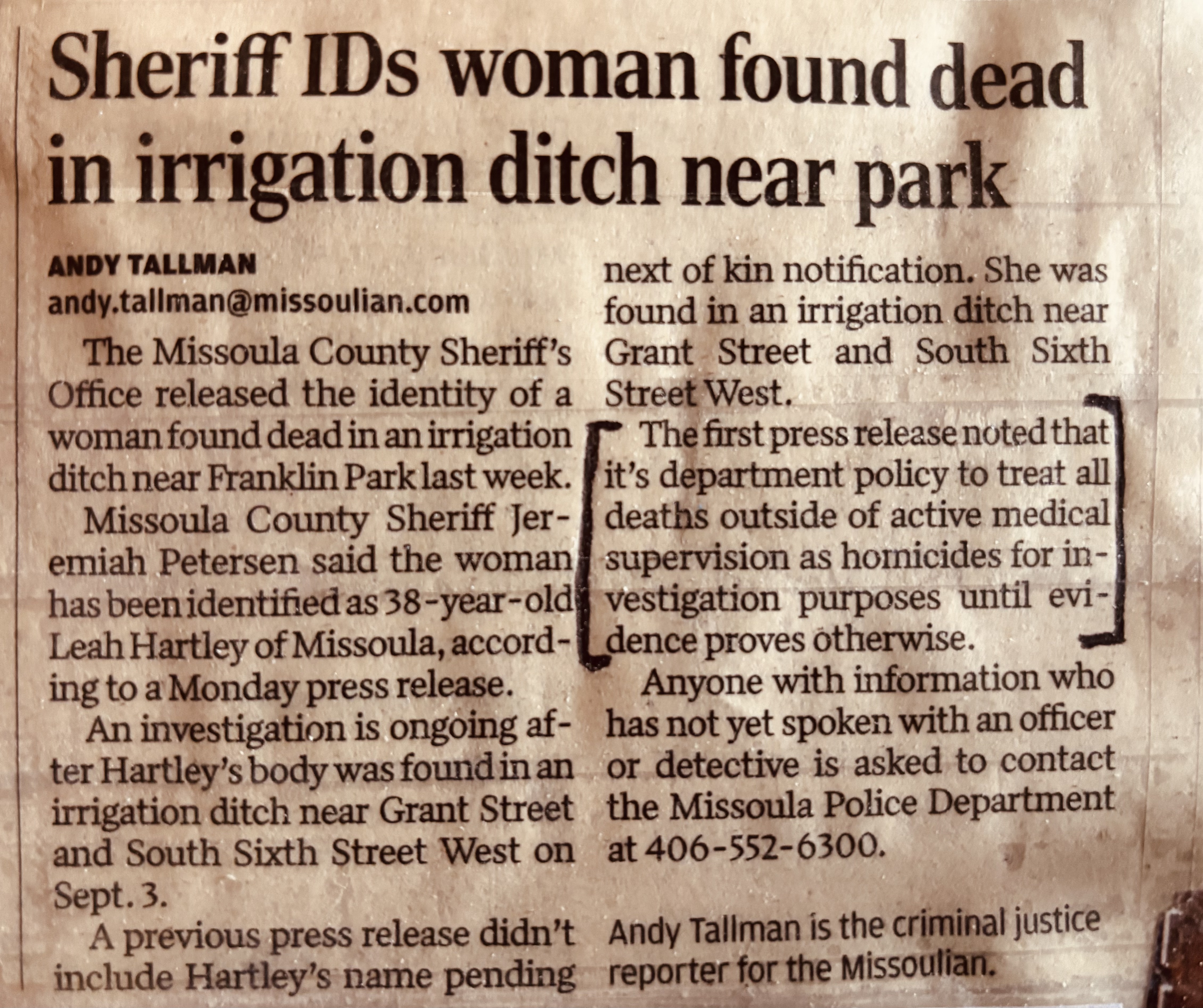
Why make such a broad declarative statement about department policy? What was happening in the fall of 2025 that could have law enforcement suddenly interested in presenting this department policy to the public? Could developing a draft plan of the Midtown Commons project, which would entail TAKING ON LEGAL LIABILITY for the city from the ditch company, have been a factor in declaring to the Missoula public that “all deaths outside of active medical supervision” would be treated “as homicides for investigation purposes until evidence proves otherwise“?

With this new liability the city appears to be taking on through the development of the Midtown Commons project in mind, I biked down the multi-modal trail to where open water flows, then I walked through the property that will radically change when the big machinery finally comes to alter this landscape.
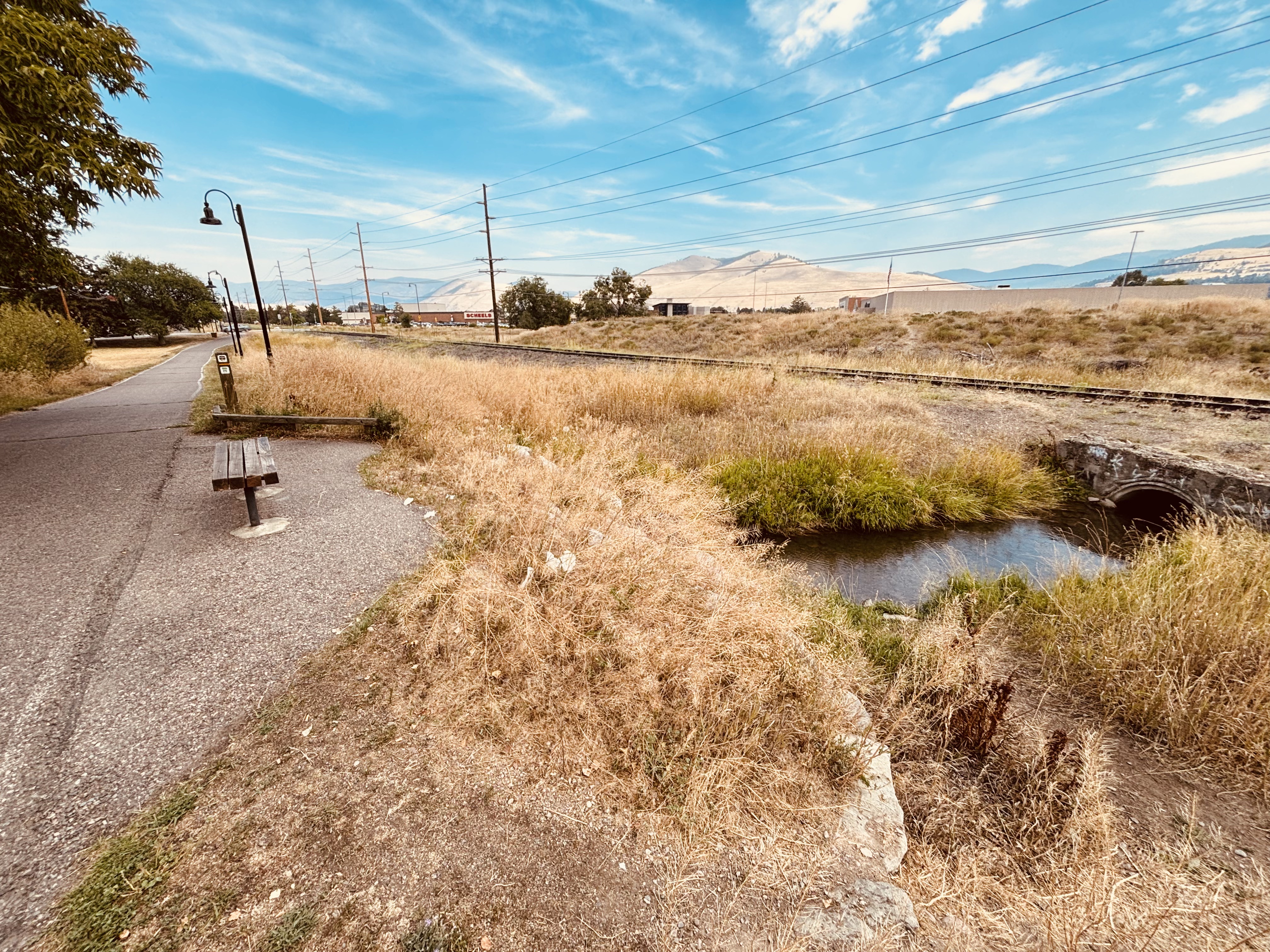
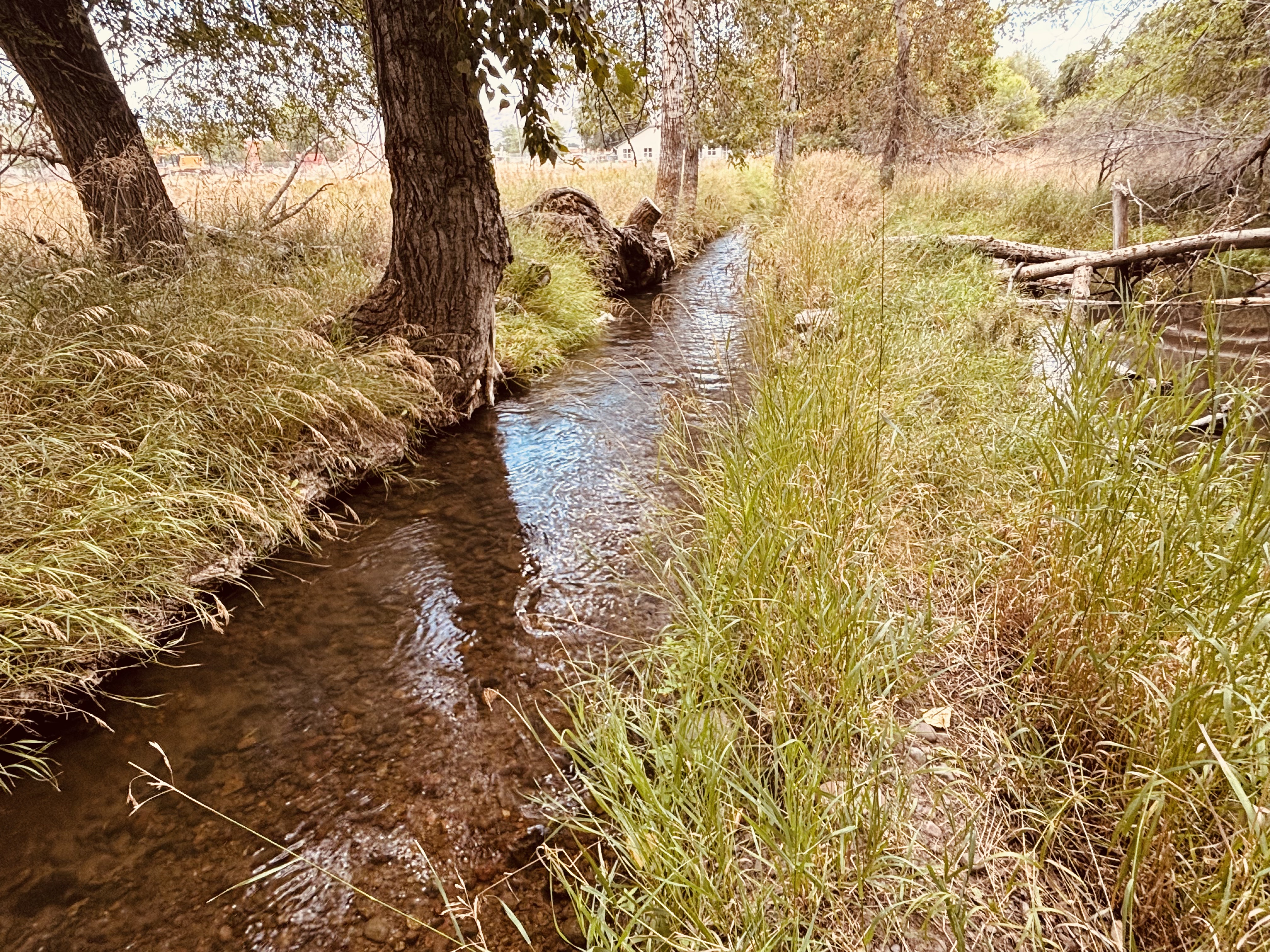
Currently there are no legal repercussions that can be taken against the owners of these irrigation ditches if and when a citizen gets clumsy and dies in them, but after the city takes ownership of the ditch infrastructure in this part of Missoula, that will change.
Is the city prepared for this new liability? Especially as it relates to dead women and the people looking to blame someone else for women making bad choices that lead to their untimely demise?
This is where actual murder investigations might come in handy for local leaders who are sensitive to the need to avoid costly lawsuits that can sometimes arise when the consequences of self-destructive behavior goes looking for a scapegoat to blame, which we are seeing right now in the death of Katherine McCollough and the effort by her friends and family to blame Great Falls native, Reggie Watts, for her death.
Here’s a quote from the Rolling Stone article attempting to cast blame on Watts for his ex-girlfriend’s lethal drug addiction:
Friends struggled to come to terms with how, in the span of around two years, McCollough developed a once-unimaginable addiction to ketamine. And how the figure who had loomed largest over the 36-year-old’s life was now absent: her most recent ex-boyfriend, Reggie Watts.
Had it not been for McCollough’s all-consuming relationship with the popular musician and comedian, nine of her close friends and sister tell Rolling Stone, they believe she would still be alive. They say that McCollough, to quote one friend, wouldn’t have “fried” her brain without Watts’ encouragement to take a heavy array of psychedelics and designer drugs in the name of intimacy and enlightenment. And that following McCollough’s drug-induced manic episode, which prompted Watts to break up with her, a despondent McCollough wouldn’t have secretly traveled to Peru in March to take her life.
When something tragic happens it’s natural to look for someone to blame, especially if the tragedy occurs to a member of a protected class who can’t be held accountable for their actions. Knowing this, and combined with the tendency of people who drink until they’re a danger to themselves and others in Missoula, it now seems prudent for local law enforcement to convey to the public that ALL dying outside, in irrigation ditches and elsewhere, will be investigated as homicides until evidence proves otherwise.
My public comment last Thursday to the MRA board, though a bit garbled, was my first attempt at framing this new incentive to treat all clumsy women (and sometimes men) who die in water as possible victims of homicide. I even offered the possibility of hiring a private investigator, like Guy Baker, to help the city avoid legal liability in future cases where it might want to challenge the “accidental” nature of how people, especially women, seem to die in and around our liberal mountain town all too frequently.
In Leah Hartley’s case, local Detectives had a person of interest who Leah had called 911 about before her death, but since she was drinking heavily and acting crazy, it was easy to look past that man’s role in her life, which included hiring her to work at his place of work, and finding her an apartment to live in, which just happened to be the one below his apartment.
For the Midtown Commons project, where city leaders have determined the cost/benefit of taking on legal liability through indemnification is a risk worth taking, my perspective doesn’t need to be taken into consideration because our city leaders are VERY GOOD at narrative control, but for the small subset of killers I think we have living in this region, you might want to avoid dumping dead bodies anywhere the city has a financial interest to conduct a REAL murder investigation.
If you appreciate my citizen journalism, which I produce as a 26-year resident of the town I’m writing about (unlike, say, Nick Shirley) please consider donating to my new GoFundMe page. Any little bit helps.
Thanks for reading!
