Where to begin with Ben Davis?
I guess a good place to begin is where The Pulp begins, and that’s with current job, past job, and political office sought (HD 93):

Global “intelligence” firm, you ask?
Yes, and they employ the kind of people you’d expect.


So, after working with Matthew EPSTEIN and CIA Janice, who did Ben Davis (first referenced by me in this 2022 Zoom Chron post) rub elbows with at Friends of the Children?
Amy Tykeson, I assume, since she lives in Ovando, Montana.

Who is Amy Tykeson? Where did she get her money? And, more importantly, where does that money go? Let’s find out!

Amy is the daughter of Donald Erwin Tykeson, a man from humble beginnings who worked in the same industry my father worked in: telecommunications.
Tykeson worked in the communications industry throughout his adult life, beginning in sales at The Oregon Journal, and then managing and buying minority interest in Liberty Communications/KEZI of Eugene, Oregon. He purchased Bend Cable in 1983, which became BendBroadband.
By 1983, when his firm was sold for US$186 million to Tele-Communications Inc., it “had become one of the top 20 cable operators in the nation.” Tykeson was a founding board member of C-SPAN.
Amy, the steward of Daddy’s telecommunication money, now helps steer the philanthropic aims of timber money, which is where Duncan Campbell got the resources to launch Friends of the Children:
Duncan Campbell, a Portland Native, had a rough past before he founded one of the nation’s first timber investment firms, The Campbell Group. Neglected from an early age by his alcoholic parents, he worked three jobs to put himself through school and always said that, if he became wealthy, he’d come back for those children who have experienced the greatest amount of trouble and heartache in their short lives.
For more context on this “timber investment firm” here’s some info about when they got into bed with Plum Creek in 2008, which produced this result:
Plum Creek Timber Company, Inc. (NYSE: PCL) today announced it will form a joint venture with The Campbell Group LLC (Campbell Group) that will allow PlumCreek to capture the value of approximately 454,000 acres of investment grade Southern timberlands. The transaction values these timberlands at $783 million, or approximately $1,725 per acre. PlumCreek will contribute the timberlands to the joint venture and an investment fund sponsored by Campbell Group will contribute $783million in cash. Campbell Group, a timber investment management organization based in Portland, Ore., will manage the joint venturelands for continued timber production. The timberlands are located insix states including Oklahoma, Arkansas, Mississippi, North Carolina, South Carolina and Georgia.
“This transaction highlights the value of our Southern timberlands and is both earnings and cash flow accretive for Plum Creek. The formation of this joint venture allows Plum Creek to immediately capture substantially all of the value of these timberlands and to maintain an ongoing interest in their continuing cash flow and potential for growth,” said Rick Holley, president and chief executive officer of Plum Creek.
John Gilleland, president of Campbell Group, said, “On behalf of our investors, we are extremely pleased to enter into this joint venture with Plum Creek. The 454,000 acres are strategically located in well-established log markets and provide for management efficiencies with the Campbell Group’s nearly 2 million acres of Southern timberland assets currently under management. We look forward to continuing to manage these lands responsibly and under the requirements of the Sustainable Forestry Initiative(R) Standard.”
Considering the timber land origin story of Friends of the Children, how ironic is it that Ben Davis married Monica Tranel’s sister, moved to Montana, and now extolls the virtues of PUBLIC LANDS?

Davis moved to Montana about a decade ago after marrying a Montanan — fellow attorney Adrienne Tranel, the sister of Monica Tranel, a Democrat who previously ran for Congress in Montana and is now running for Legislature in House District 92.
“I married a native Montanan and we’re really proud to make this our home. I have four children who attend public schools, and this is just the place that we love. I think that the people are unique in their love of public lands and their individuality, their passion for community and love of place. I think there’s a lot to love that is unique about Montana.”
While Friends of the Children has NATIONAL reach, including “indigenous locations”…

…it’s the local influence of charitable money controlled by Friends of the Children board secretary, Amy Tykeson, that I find most illuminating, so here’s some screenshots I curated from the publicly available info on the Tykeson Family Charitable Trust to consider before the primaries hit Tuesday, including money to the Montana Free Press, which employs the reporter that The Pulp used to report on Ben Davis in the first place.


One more thing about philanthropically befriending children that’s important to understand, and that’s how very bipartisan befriending children is in Montana, as Republican Governor, Greg Gianforte, has clearly shown:

To keep voters compartmentalized and retarded it will be very important for our local media to reinforce the fiction that Democrats and Republicans are distinct political parties with opposing values and policy ideas. Outlets like the Daily Montanan, for example, will amplify Davis’ sister-in-law, Monica Tranel, as she exploits the DATA CENTER freakout while ignoring and/or downplaying the fact Tranel got busted outsourcing her own Public Defender workload to AI.
Officials from NorthWestern have said data centers are not a relevant part of the merger, but Wednesday, the second day of the hearing, a lawyer quizzing the CEO showed the “large load customers” are a factor given statements in an earlier investors call and recent financial report.
Wednesday, NorthWestern CEO Brian Bird took the stand, and under questioning from lawyer Monica Tranel, Bird agreed he had discussed data centers as an opportunity for NorthWestern with the possible merger.
But Bird said the merger offers other opportunities for growth too, not just from data centers, but also from transmission and generation, and he said the benefits for shareholders will, over time, accrue to customers as well — but the merger needs to take place.
“There ultimately could be reduced costs to customers,” Bird said.
While I suspect most readers will be skeptical about Bird’s claims, I wish they were more skeptical about EVERYTHING being reported about the professional liars we call politicians, like AOC, who recently gave hundreds of Democrats in Missoula a boost to keep their delusions alive that shifts in rhetoric represent shifts in reality.
Rep. Alexandria Ocasio-Cortez said Wednesday that she is now opposing all U.S. military aid to Israel, a shift in her previous position that made exceptions to support Israeli efforts to defend itself.
The new stance distinguishes Ocasio-Cortez, D-N.Y., from both leaders in her party and other potential 2028 Democratic White House contenders, should she launch a presidential run.
AOC was in town to sell Democrats on Sam Forstag, the Smokejumper candidate who obviously won’t be pitching his agency’s historic relationship with the CIA as a selling point, just like Ben Davis won’t be talking about his former Kharon/CIA colleague, Janice, working to protect Israel from charitable money going to Hamas.

I also don’t expect to hear anything too critical from Ben Davis toward Governor Gianforte, who, if you follow his money, goes back through Oracle to…YOU GUESSED IT! The CIA!
But don’t take MY word for it.


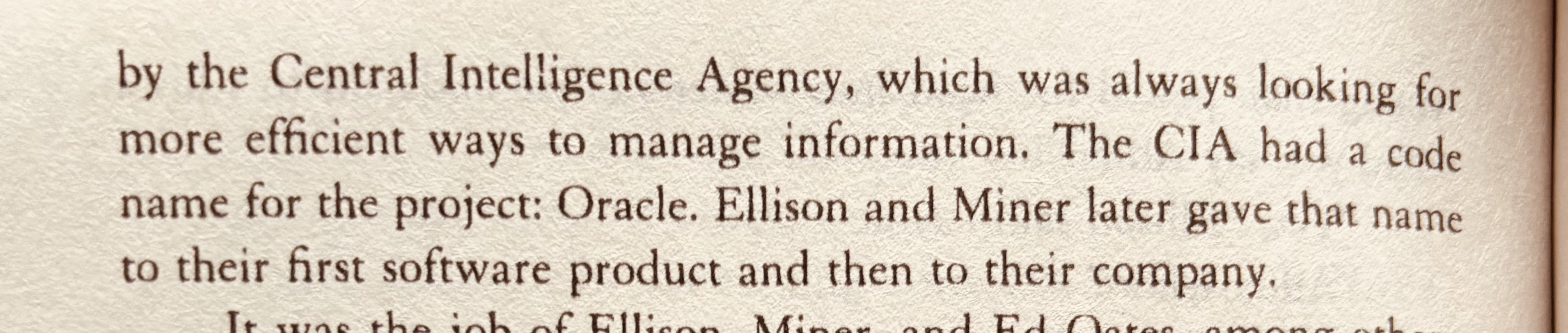
Turns out, when you do what Deep Throat suggested decades ago, you see how compromised the entire political landscape has become in this country.
Thanks for reading!