

Today I’m going to reference several nurses and one celebrated male incel shooter as I provide some historical context on the cultural shift underway after the Lindsay Clancy mistrial was declared last week.

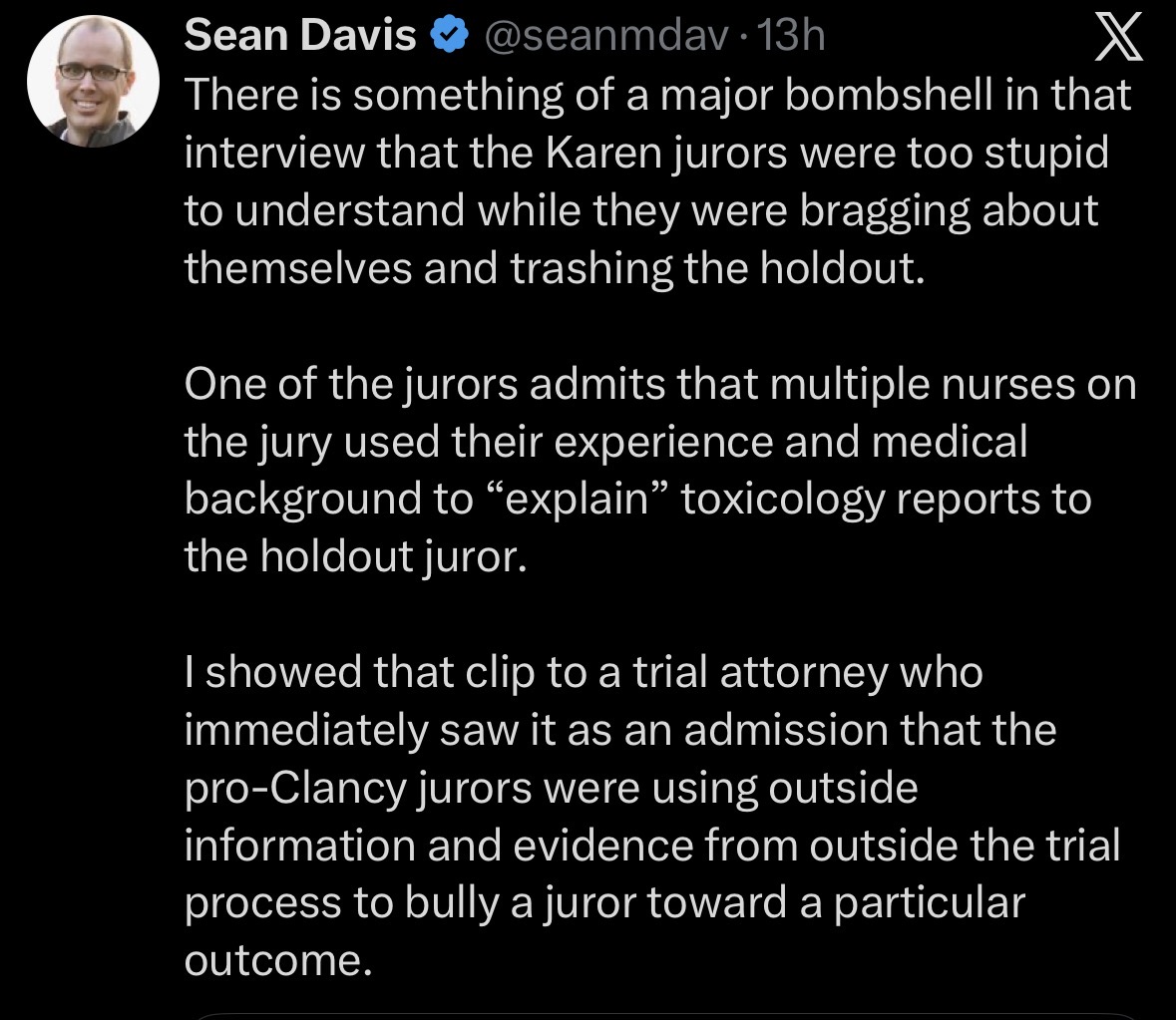
The claims now flying in the court of public opinion from members of the jury frame the “very arrogant” rogue holdout as being impervious to what anybody had to say, including nurses serving on the jury.
Female jurors from the Lindsay Clancy trial criticized the lone male juror who opposed a not-guilty-by-reason-of-insanity verdict.
One juror said:
“He was very arrogant. He really didn’t take anything that anybody said.”
She claimed he disregarded information provided by nurses serving on the jury.
Another juror said:
“He admitted he had reasonable doubt, and I started filling out the forms. I was so excited.”
She added that he later said:
“But I’m still not gonna say that she’s not guilty by reason of insanity.”
A third juror questioned whether he should be described as “rogue” but acknowledged the frustration inside the deliberation room.
So a nurse serving on the jury in a case where the defendant was also a nurse? Maybe we should learn more about the experiences of nurses and how they handle conflict in the workplace.
As surprising as it may be, healthcare professionals don’t always treat each other with kindness and respect. In fact, research suggests that lateral violence in healthcare is a serious issue. Also referred to as horizontal violence or bullying, lateral violence is defined as non-physical, aggressive, hostile, and/or harmful behavior between coworkers. While individual acts of lateral violence can appear relatively harmless, they create a toxic environment that takes a toll on employees’ morale, hindering the success of the healthcare institutions for which they work.
…
While anyone can engage in lateral violence, it is typically perpetrated by individuals who view themselves as superior to other members of their team. Organizational managers and directors are the most frequent perpetrators of lateral violence against nurses, making it difficult for lower-level nurses particularly, to report their abuse. However, nurses with the same job title also commit lateral violence against their peers. In these cases, it is typically the seasoned nurses who victimize those who are new to the profession or new to their organization.
For anyone who remembers the Ken Kesey novel, One Flew Over The Cuckoo’s Nest, Nurse Ratched wasn’t known for her nurturing bedside manner. Instead, this is how the Wikipedia entry describes her:
Nurse Ratched is the head administrative nurse at the Salem State Hospital, a mental institution where she exercises near-absolute power over the patients’ access to medications, privileges, and basic necessities such as food and toiletries. She capriciously revokes these privileges whenever a patient displeases her. Her superiors turn a blind eye because she maintains order, keeping the patients from acting out, either through antipsychotic and anticonvulsant drugs or her own brand of psychotherapy, which consists mostly of humiliating patients into doing her bidding. Her tyrannical rule and her cruel personality stem from her time as an army nurse during World War II.
Nurse Ratched is just a fictional character, one might say, so why bring up a fictional character as an example when the REAL nurses on the jury were just trying to convey their expertise to the arrogant holdout who weirdly thought the premeditated murder of three innocent children should lead to some sort of punishment instead of sparking a solidarity movement because so many women apparently also want to murder their children.
So, what could be wrong about bringing the nursing expertise into the jury room?
The incel shooter I mentioned at the beginning of this post is worth bringing into our examination of nursing because there’s a strange irony lurking in his backstory that isn’t included in the movie version of what happened in Montreal in 1989 at the engineering school he shot up.
Since Hollywood’s hottest director, Denis Villeneuve, didn’t think the killer’s backstory helped develop his admittedly feminine-centric worldview, I emphasized the elements of the shooter’s backstory that I found relevant for a podcast episode (not out yet) I recorded Monday with Thomas from PsyOp Cinema.
After the divorce became final in 1976, the Lépine children, then aged 12 and 9, returned to live with their mother, who had been promoted to director of nursing at a Montreal hospital. In 1977 the family moved to a house purchased in the middle-class Montreal suburb of Pierrefonds. Gamil attended junior high and high school, where he was described as a quiet student who obtained average to above average marks. He developed a close friendship with another boy, but he did not fit in with other students. Taunted as an Arab because of his name, as a teenager he legally changed it to “Marc Lépine”, citing his hatred of his father as the reason for taking his mother’s surname. Lépine was uncommunicative and showed little emotion. He suffered from low self-esteem, exacerbated by his chronic acne. Family relations remained difficult as his younger sister Nadia publicly humiliated him about his acne and his lack of girlfriends. Lépine fantasized about her death, and on one occasion made a mock grave for her. He was overjoyed when in 1981 she was placed in a group home because of her delinquent behaviour and drug abuse.
Seeking a good male role model for Lépine, his mother arranged for a Big Brother. For two years, the experience proved positive as Lépine, often with his best friend, enjoyed the time with photography and moto-cross motorcycles. However, in 1979, the meetings ceased abruptly when the Big Brother was detained on suspicion of molesting young boys. Both Lépine and his Big Brother denied that any molestation had occurred.
Instead of having any of this narrative sully the director’s vision for bringing this shooting to the Big Screen, it’s totally omitted so the female survivor can say this about her unborn child at the end:
“…if I have a boy, I will teach him how to love; if I have a girl, I will tell her the world is hers”
Human babies enter this world with no concept of gender–that’s formed culturally by mothers AND fathers as a baby matures–so if understanding where things go wrong is something we, as a society, actually want to do, we can’t keep doing what we are doing, as a society.
Put more simply, let’s make Nurse Ratched fiction again!
Thanks for reading.