
I started hearing about problems with Russian immigrants years ago when I worked at the homeless shelter. The Poverello’s food pantry program, which saved food from local grocery store dumpsters, dispersed food to low-income clients, and some of that food would later be re-sold by “the Russians” out on Mullan road, just a few miles from their Slavic Pentecostal church.
Two surnames related to this immigrant community, Tsuber and Chinikailo, became quite familiar to me, and today I’m going to provide a little context about this immigrant community, since a member of this community has been recently charged with soliciting sex from a minor.
On August 12, 2026, around 1:41 pm, an online application user, later identified as 24-year-old Matthew Tsuber, requested to connect with another online application profile that was being used by a detective. The latter profile depicts a fictitious young female who quickly messaged Tsuber that she was 12 years of age or younger. Upon learning of the believed child’s age, Tsuber responded: “Yeah I’m not sure about that” in relation to the age. The detective replied, “Oh k whatev [peace sign emoji]”. Tsuber then responded: “You want to hook up?” Tsuber then asked for a photo of the believed child.
The above messages were all exchanged in less than one minute. The conversation continued, with the detective stating, “I mean I’m cool if ur cool lol”. Tsuber replied, “Ya just don’t say that I raped you [laughing emoji]”. Tsuber again asked for a photo, to which the detective replied that Tsuber could send one first. Tsuber then sent a photograph clearly depicting the face of a person law enforcement has identified as Matthew Tsuber.
In today’s post we’re going to learn some fascinating history about Russian immigrants in this part of the country, including a modern interpretation of their culture, as expressed to me by former Detective, Guy Baker, after I called 911 on a creepy looking dude standing by a young girl selling roses on Higgins in 2022.
Here’s what I wrote four years ago about my little chat with Detective Baker regarding the flower girl and local law enforcement’s pathetic response after I called 911 (when Baker finally called me back, the caller ID said FBI):
The follow up call came a few days later, and I guess it was intended to put my concerns to rest. I was told by Detective Baker that a vigorous 6-8 hour investigation revealed the man was indeed a Russian out-of-stater traveling with his “family” from western Washington. There were two boys and a woman who appeared to be the “mother”. This family’s behavior had caused another bystander to call 911 two days after I did, and this concerned citizen took pictures, something Guy Baker suggested I could have done to make his job easier.
At the end of the day those red flags that had caused our concern were chalked up to “cultural differences”, so I guess it must be a Russian thing to avoid answering direct questions about familial ties and to express fear about the goal of your fundraising efforts. Thankfully history shows us the Russian character is strong and perseveres beyond adversity.
The same year girls selling roses got my attention, this floral marketing strategy also got the attention of authorities in Eastern Idaho, but nothing came from the “research” done by the Bonneville County Sheriff’s Office into this phenomenon:
The Bonneville County Sheriff’s Office is aware of the flower sellers and has looked into the situation.
“We’ve seen them selling (roses), but we haven’t seen any evidence that they’re doing anything illegal or dangerous,” says Bonneville County Sheriff’s Office spokesman Sgt. Bryan Lovell. “We’ve done some research and rumors have been spread wildly over social media in a lot of different ways, but it’s unfounded.”
When you turn the time-dial back to 1943, before the Cold War kicked off, the movement of Russian immigrants into America was a specific concern for Major Jordan, who wrote the following in his diary about the flow of Russian immigrants from the pipeline previously servicing the war efforts (excerpt from Cold War Montana, by Ken Robison):
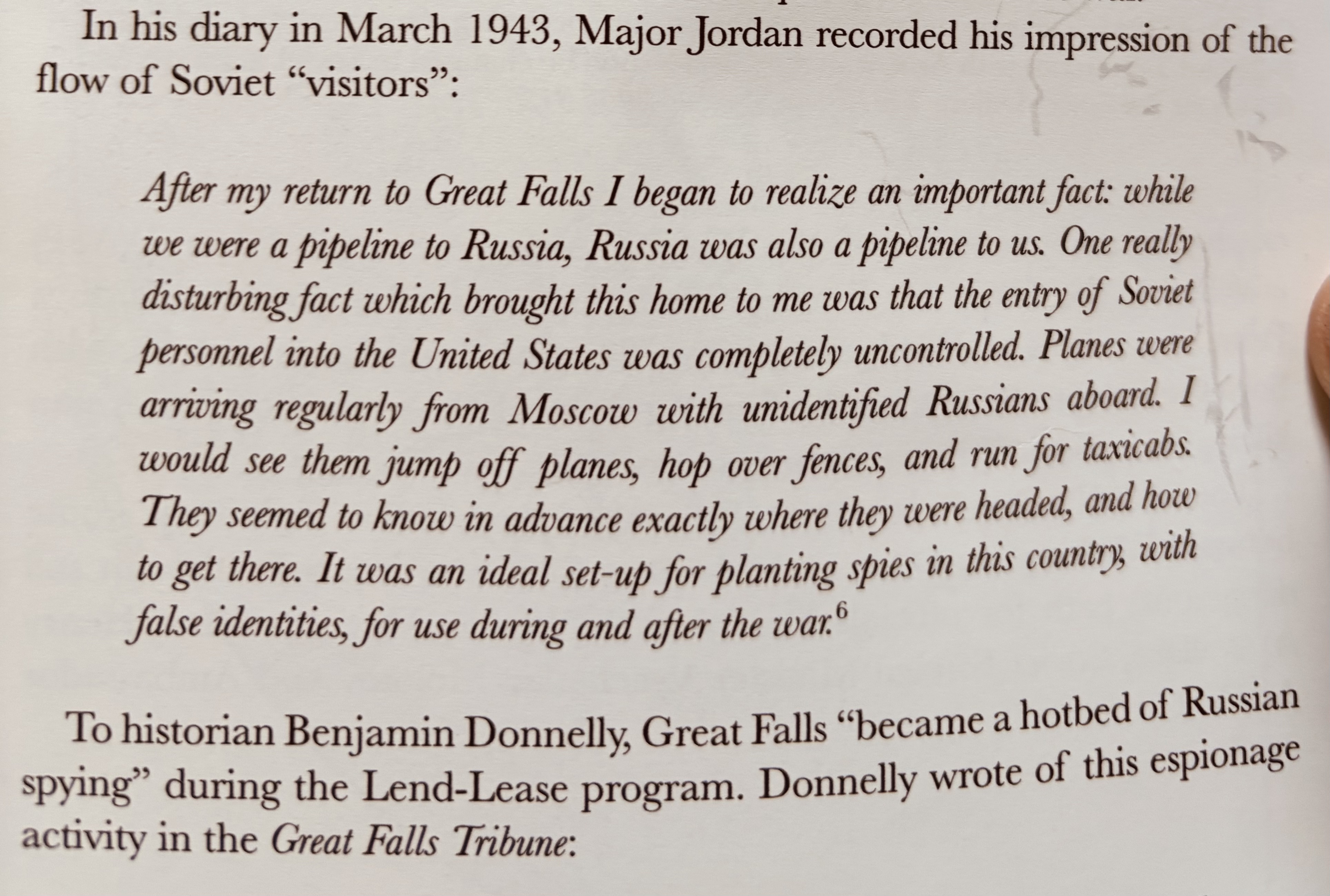
The quote from the Great Falls Tribune that follows describes the commander of the “Soviet side”, Col. A.M. Kotikov, as being well-known “in aviation circles”, then further describes the broader community of Russians as being: “…generally well-liked, though the officers acquired a reputation for not paying their bar tabs.“
Interesting.
The real gem I found this morning while doing research is a 1995 graduate student thesis by University of Montana student, Emily Barton, and the reason I found it is because I was searching the surname “Chinikailo”.
Here’s a screenshot of the title page, along with the first appearance of the name that would help set the tone for future assimilation, or lack thereof, of Missoula’s Russian refugee community:


The more I read, the more I thanked Emily Barton in my head for doing her graduate work on this subject, which included the resistance of this refugee community to use a local program offering jobs.
Wow.


This “black market” mentality has persisted, I would argue, with the admittedly large families that have settled in the Missoula valley. Side hustles include trafficking guns and rampant car-theft, as I learned in an anecdotal story one day at my garage sale.
After telling the stranger about why I think you’ll always hear fat Russians speaking Russian when you go for a soak at Symes Hot Springs, the stranger (a retired reporter, I found out) told me a quick story about Karl Tyler, the automotive dealer, and his problems with a few cars every year getting stolen off one of his car lots.
When approached by religious leaders to buy the land that became the Slavic Pentecostal church on Mullan, Karl Tyler had an interesting clause he added to the contract, paraphrased like this: if one more car gets stolen from me, Karl Tyler supposedly said, the land will revert to my ownership.
According to this stranger, Karl never again had a problem with cars being stolen off his lots.
Going back to the grad-student’s research, here’s more about the lack of success Mr. Chinikailo had getting Russian refugees to get jobs:


With big families of any nationality, a wide array of characters are represented, so I’m not trying to indict everyone with a surname as being complicit in black market activity simply because cultural and structural factors may make that likelihood a greater probability.
I mean, at least one “Tsuber” learned about the law and how to politely thank the important people on their special day!


Of course, not every Tsuber and Chinikailo manage to keep themselves clear of involvement with criminal activity:
A Seeley Lake woman who purchased a firearm for a prohibited person was found guilty by a federal jury yesterday, U.S. Attorney Kurt Alme said.
Following a one-day trial, Alyssa Mikkel Tsuber, 32, was found guilty of one count of false statement during a firearm transaction. Tsuber faces a potential term of imprisonment of 10 years, a $250,000 fine, and 3 years of supervised release.
Before committing this crime, Alyssa was commenting on Facebook about a different crime and her apparent knowledge about what happened.


At least this community has a place where they can ask God for forgiveness . That’s good, right?


In summary, I think Guy Baker may have been right in 2022, and my confusion really did stem from my cultural misunderstanding. I think I understand things better now.
If you would like to help me continue mapping out the Missoula community I’ve called home for 26 years as a refugee myself from midwest suburbia, then you can donate to my new GoFundMe page. Any little bit helps.
Thanks for reading!

It’s more accurate to say Russian speaking, as many are refugees (or descendants) of Ukrainian and Georgian refugee’s. As you correctly pointed out, they were brought to Missoula as part of the Refugee program that today brings Artitrean’s and Congolese refugee’s to Missoula. The list of countries that are given refugee status is determined by the sitting president. Back in the 80’s and 90’s it was Ukraine and Georgia, for supposed religious persecution.
It’s really a CIA program to recruit and train future insurgents in those same countries. They prop them up for 2 years in an isolated, and highly surveilled community with the language skills to eavesdrop on them, and keep them dependent. Then after 2 years they pull the financial plug. Those that can’t integrate, often young incel men, end up having to return to there former country, where the CIA can then dangle money and power to them, if they’ll just do some small work for the CIA.
It’s the long tail of the CIA’s regime change strategy to destabilize countries from within.
A constructively critical comment! Agreed, so I changed the title to “Russian-Speaking Immigrant”.