

The use of a “jail diversion” pre-trial program got some attention recently because of a class-action lawsuit in Ravalli County that made some claims about the costs burdening those merely ACCUSED of a crime, not convicted of one. From the link:
A jail diversion program in Ravalli County upends important values of the justice system by forcing defendants to pay hundreds of dollars a month in fees before they’re ever found guilty, lawyers alleged Monday in federal court.
In the class action lawsuit, lawyer Phil Telfeyan of Equal Justice Under Law said one man who is disabled and whose only source of income is his Social Security check of $1,100 was billed $1,073 for the fees, leaving him $27 for all of his needs.
“He’s become homeless for the very first time in his life at 71 years old,” Telfeyan said.
So, what was the original intent of this program, run by the Ravalli County Sheriff’s Office, that’s making people like Phil Telfeyan homeless?
The Sheriff’s Office runs pretrial supervision, and Young said the idea behind it was to create a self-funded program and ensure accountability, which hadn’t taken place before 2018.
The idea is to “ensure accountability” for people who aren’t being accountable to the process, like showing up for scheduled court hearings. Is it working?
Sandra Martin, of Corvallis, testified that she was arrested for a failure to appear, and she had to pay $56 twice a week for urinalysis tests plus $105 a month for “pretrial services” — or $553 a month.
Martin said she didn’t ever get a call or a visit or help with housing or counseling as part of the pretrial fee, but she couldn’t afford to pay the costs anyway.
Her husband peeled logs for $1,600 to $2,000 a month while she cared for their grandchildren, for which the couple was financially responsible.
When Martin informed the pretrial supervision officers she couldn’t afford the fees, she heard it didn’t matter, she said.
“They said it was unfortunate, but I didn’t have a choice,” Martin said. “I was either going to pay the fine, pay the fees, or I was going to be kicked out of the program and go back to jail.”
The demand to either pay or go back to jail sounds like a threat from a shake-down, not “help” to be “accountable” to the judicial system.
Moving north, to Missoula County, here’s what the Missoula County website claims pre-trial supervision programs can do for people forced to be a part of them:


While I haven’t been in this program long, what I can already report from my “lived experience” is that unprofessional conduct putting my “freedom” at risk has already occurred with the person tasked with doing things like providing “assistance for housing, employment, transportation…” for her client (me), and my attempt to get these issues addressed by a supervisor have been ignored for a week.
To better understand what kind of “risk” I pose to the Missoula community, let’s check out my stats from pre-trial’s assessment of my criminal history:
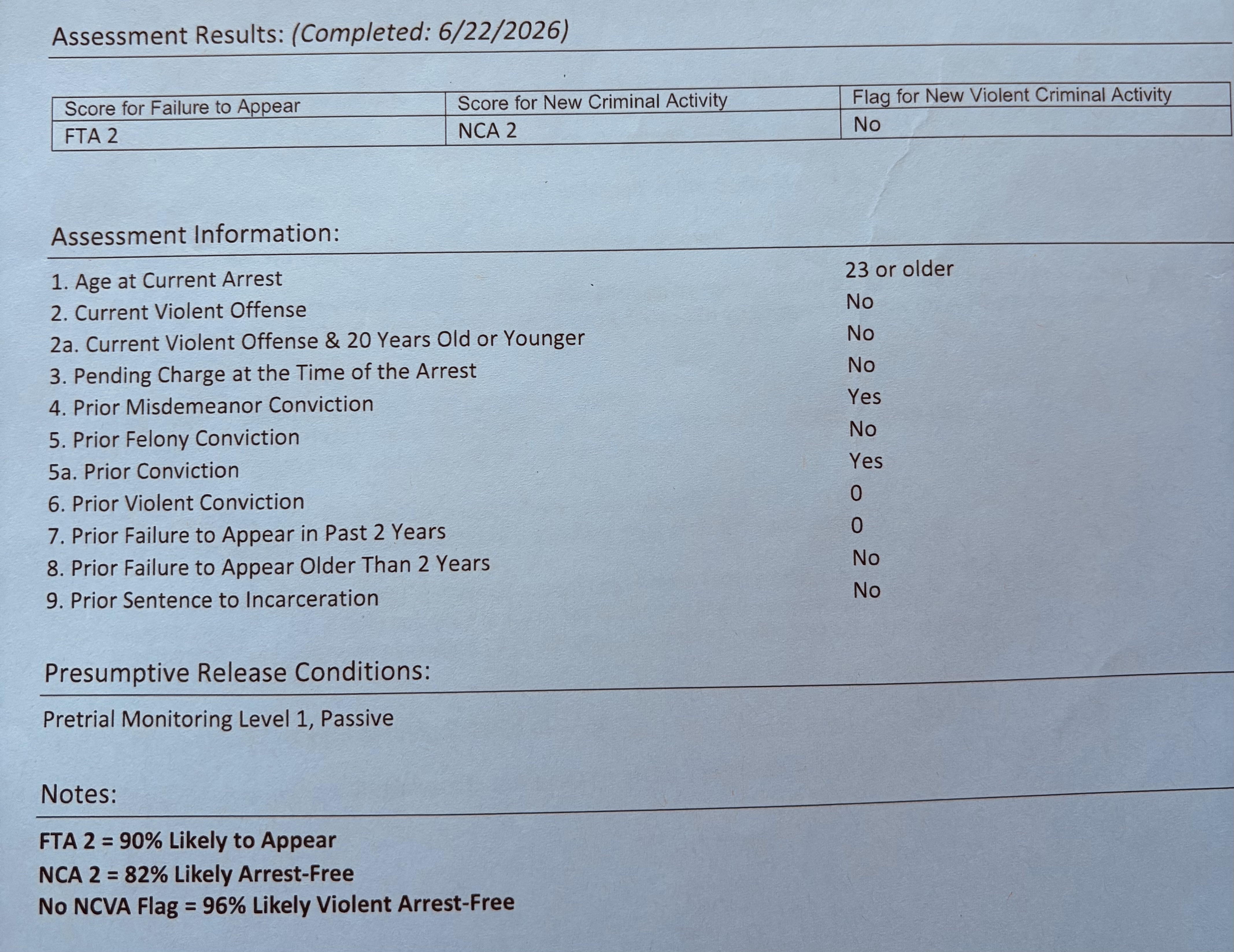
According to the stats, there’s no violent criminal history, there’s no “failure to appears”, there’s no pending charges at the time of my arrest, and I’m 90% likely to appear for future court dates.
Instead of getting “help” and “support” from pre-trial supervision, my experience more closely aligns with the description in this report, which frames programs like the one I’m being manipulated by like this:

Have you ever walked into a meeting with your lawyer for the first time and your ankle monitor is beeping because your pre-trial compliance officer failed to send an email two days previous to ensure that entry into this forbidden zone for said meeting didn’t result in a technical violation of conditions of release?
I have.
If this was the only whoopsie, maybe I’d be a little more understanding, but I’ve already documented other troubling examples of new barriers being created by either incompetence, or something else, and I’m not the kind of “client” to sit back and allow myself to be further manipulated by cogs in this systemic meat grinder.
Going back to the report, done by the Urban Institute, here’s why they claim scrutinizing this process matters:

While I don’t often comment on the PTSD that lurks in shadows of how I interact with the world, the violence I was in proximity to working at the Poverello Center became acutely clear two years in, in 2010, when my co-worker was stabbed by a drunk client after being denied services.
For context, this article describes the legal argument his lawyer made for reducing his sentence after years already spent behind bars:
Briscoe went to the Poverello Center on June 28, 2010, seeking a shower after soiling his pants. But a worker there refused to let him in because Briscoe was drunk. He’d begun his day by drinking two-thirds of a quart of vodka and three or four beers, according to court documents. A breath test showed a blood alcohol level of .166, more than twice the legal driving limit.
After being turned away from the Pov, Briscoe returned and stabbed the man, according to court records.
Much of Thursday’s hearing focused on Briscoe’s alcoholism, as well as a nine-year stretch of sobriety when he lived in Chippewa Falls, Wisc., and worked at an alcohol treatment center.
There, he had a reputation as a compassionate man and hard worker, who’d be welcome to return to his former line of work there, according to testimony presented at the hearing.
His belligerence at the Poverello Center was an alcohol-fueled aberration, Boggs said, featuring “things that were said by a drunken man … (who’d) reached absolute bottom.”
Briscoe himself told Townsend that “I am an alcoholic. Alcohol has run through my life.”
Boylan said the true aberration comprised Biscoe’s nine sober years in Wisconsin, pointing out that even when incarcerated, Briscoe was caught this past September drinking “pruno,” an alcoholic jailhouse concoction.
Townsend pointed out that nowhere in Briscoe’s presentence report does he say he’s sorry.
Psychologist Janet Allison, who interviewed Briscoe extensively, testified that “he felt very bad about himself” because of the incident.
“Is that not another way of saying he’s sorry he got caught?” Townsend queried.
She again sentenced Briscoe to 20 years in prison, but this time suspended five years.
No, I don’t think John Briscoe was ever sorry that he attacked and stabbed my co-worker, who I was supervising at the time, because there are other things that wouldn’t be in a “pre-sentence report” that contributed to the dangerous atmosphere at the Poverello Center.
Right, Eran Pehan? Isn’t that why we settled with Tom and his lawyer when he sued us?
After my co-worker was stabbed, I was targeted by some unstable clients and had to take out several restraining orders. I also had weapons pulled on me several times, so yeah, PTSD, but I’m not bringing this up for sympathy. No, I’m referencing my own struggles because the conduct of alleged “professionals” gaslighting me behind the scenes right now is, I believe, part of a strategy, and it’s one I am saddened to see occur, since some of these people knew me when I was the coordinator for the Homeless Outreach Program from 2010 to 2016, when I recognized my own significant “burnout” and left on my own accord.
While it might seem outlandish to claim, there’s a chance what’s coming down on me like a snowball made of shit is, in part, the result of my Big Sky Epstein Network coverage, like this post about Sultan Sulayem, Missoula Probation and Parole, and someone involved in P&P who is now a judge…the same judge who signed my arrest warrant, I will add.
I’m sure that’s just a coincidence.

While I watch how the watchers watch me, the city of Missoula is getting sued left and right and I’m loving it. There’s the litigation to pry the report on Keithi Worthington’s unprofessional conduct from Mayor Davis’s sweaty hands, there’s the wrongful death lawsuit for how Missoula cops killed Ross Robertson, and now there’s litigation against the crown jewel of midtown gentrification, the Midtown Commons:
Residents near a public-private development in the Missoula Midtown neighborhood allege in a lawsuit filed last month that they did not have a proper ability to participate in the project.
The suit, filed by a nonprofit called Rooted in Environmental Justice on June 17, argues the Midtown Commons development was illegally approved by the Missoula City Council.
…
Lawyers for the neighbors allege the process did not follow the state Constitution’s right to participate, a right to a clean and healthy environment and did not follow local rules when selling a portion of the land.
“Members of the public, including plaintiffs, who attended the May 18, 2026 hearing did not have access to all the information that informed the city’s decision, had not been able to participate in previous meetings developing the decision and were not able to meaningfully participate in the decision,” the lawsuit said.
If you appreciate what it’s taken me over the last few years to continue pushing back against the corrupt mono-party running this town like a tyrannical fiefdom, please consider donating to my new GoFundMe page. Any little bit helps.
Thanks for reading!
