

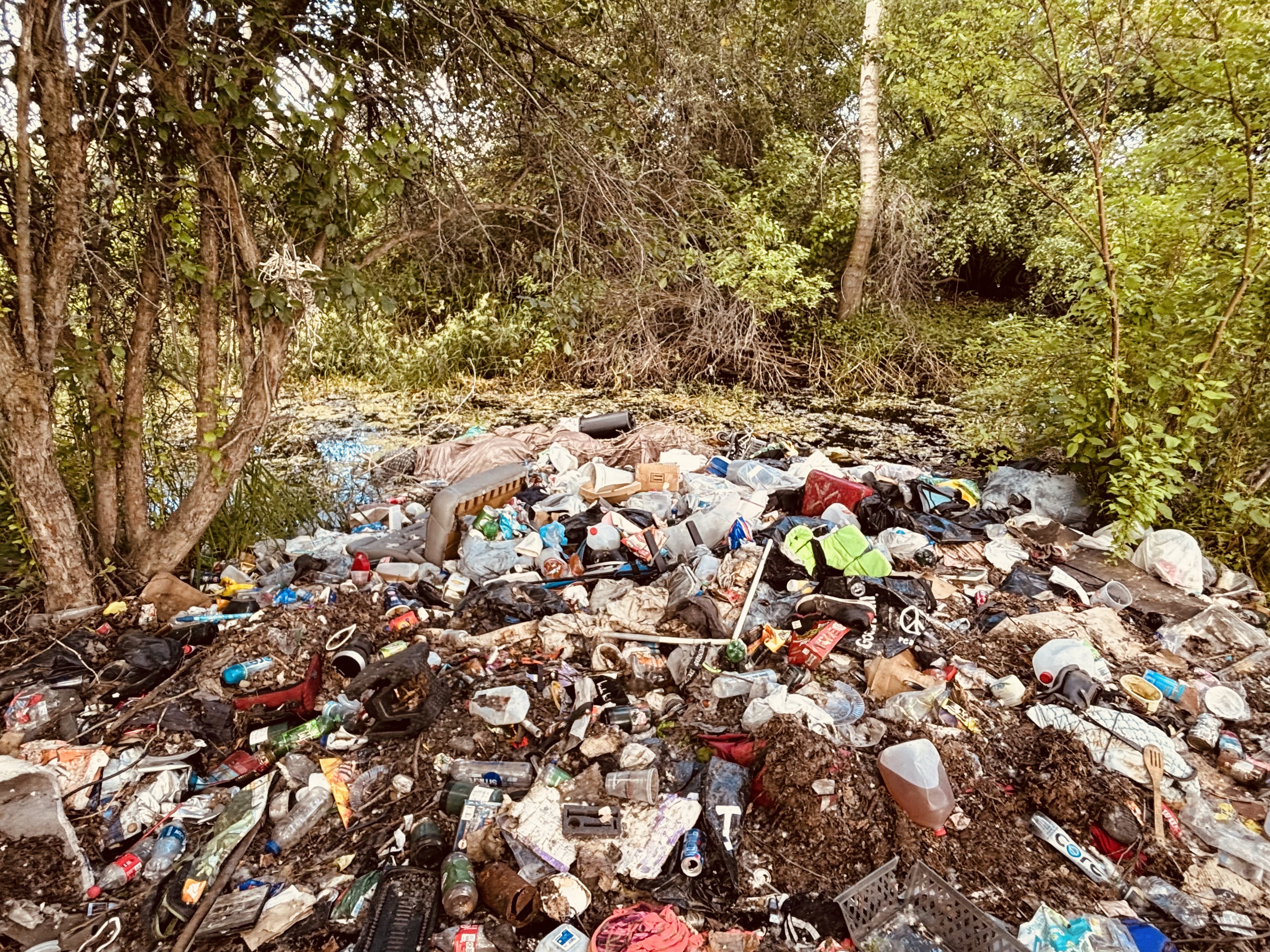
On May 4th I wrote this post about the effort to clean up some nasty urban camps near Buckhouse bridge, reporting that the function of the main camp appeared to be a bike chop-shop. I even managed to identify one of the homeless campers involved, who I connected to the dark world of meth abuse. Over a month after that cleanup started, there is STILL lots of trash sitting in stagnant water.
So, who will pay for the rest of this cleanup?

If the answer is the University of Montana, then that means YOU, the taxpayer, will somehow be on the hook for completing what Missoula Works has left unfinished. Lovely.
Missoula Works is a subsidiary of the Missoula Interfaith Collaborative, a “non-profit” that I helped the Executive Director, Casey Dunning, establish when I was still directing the Homeless Outreach Team for the Poverello Center. After my own stint of homelessness, in which I couldn’t reach out for services due to the lawfare against me, it’s nice to see that Casey Dunning is getting a decent salary for his role in employing homeless people and sex offenders, like J.D. Partain, who had to close up his youth boxing organization after being caught surreptitiously recording his adopted daughter undressing in her room.


The REAL value of an organization, like the Missoula Interfaith Collaborative doing the work they’re doing, is HOW they do it, and that’s with all the sensitivities of narrative control in mind that the donors expect. Paying some former homeless people to kinda clean up homeless trash is just PR work, intended to occur beneath the radar of community awareness.
To better understand this narrative-control function of a non-profit like the Missoula Interfaith Collaborative, let’s see what kind of organizations are donating money:


When I see “charitable” money from Gianforte and Town Pump, I think of the human trafficking LARP being carried out by Lowell Hochhalter, a man I’ve written plenty about, like how he shared a deep desire with Guy Baker to find Jermain Charlo, according to that CBS 48 Hours article I referenced in yesterday’s post about PIs in Montana.
After Charlo disappeared, her family took matters into their own hands and contacted local organization The Lifeguard Group for help. Volunteers came out in support to search for Charlo. This was just the first of many searches the community would hold over the months and years to come.
“We’ve told the family that we’re not going to stop no matter what. And we will search for Jermain as if she’s alive, until we find her,” said Lowell Hochhalter, president and co-founder of The Lifeguard Group.
Words are funny, partly because they’re so easy to throw around. Actually putting ACTION to those words? Yeah, that’s where things get tricky, because then you have to start dealing with a phenomenon I like to call reality.
Here are some words on the Missoula Works website that explains the idea of what they’re doing:

And here is the reality:
The question of “who pays” is a derivative of the time-proven “deep throat” adage, FOLLOW THE MONEY, because following the money will almost always show you the REAL influence behind stated “values” and “missions”. With that in mind, I’ll conclude today’s post with Otto Bremer, a German-born banker, like Klaus von Stutterheim, who’s legacy is a foundation that trickles down his banker money to non-profits, like the Missoula Interfaith Collaborative.


What does $7 million dollars in “philanthropic” German banker money buy you in Montana? Quite a lot, I would imagine. Yet somehow, with all this charitable money floating around, the garbage of reality persists.
If you’re inspired by my ability to do what Deep Throat suggests, my money-ask is a much more modest affair, and has garnered three donations already that I GREATLY appreciate, since financially, I’m quite a loser on paper.
But being a financial loser is where the sting of my authenticity exists, because I can genuinely say, thanks to being a financial loser, that NO big-money organization is interested in supporting the work I’ve been doing for ten years at this blog. Any money I’ve received has been individual donations from individual people, and for that support I am greatly appreciative.
Thanks for reading!

Interesting note on the Interfaith Collaborative two of its members are involved in an extramarital affair and are going to marry. Their partners were devastated and embarrassed. I thought these were supposed to be people of faith and values?
Easy to trauma-bond in that line of work.